








 FR
 EN
 ES
 PT
 RU
A flawless sample proves that a supplier can produce one good bag. A bulk order is a completely different challenge. It tests whether the manufacturer can deliver thousands or even millions of units on schedule, maintain consistent quality across production batches, and protect your brand reputation throughout the supply chain.
For retailers, food service brands, distributors, and packaging importers, choosing the wrong supplier can lead to rejected shipments, inconsistent packaging, delayed product launches, and unnecessary financial losses.
Before committing a significant portion of your packaging budget, you need to look beyond the sample and the quotation. You need to understand how the manufacturer operates, controls quality, manages production risks, and verifies its environmental claims.
Here are six essential questions to ask before placing a bulk paper bag order.
1. Do You Have an In-House Laboratory or Just a Quality Certificate?
Most established paper packaging manufacturers can provide certifications such as ISO 9001, ISO 22000, or BRCGS. These credentials are important because they demonstrate that a company has established management systems and follows defined operational requirements.
However, a certificate alone cannot guarantee that every production batch will meet your specifications.
The more important question is: How does the manufacturer verify product quality during actual production?
An in-house laboratory provides a much clearer picture of a factory’s quality control capabilities. It allows the manufacturer to inspect incoming raw materials, evaluate semi-finished products, and test finished packaging against defined technical requirements.
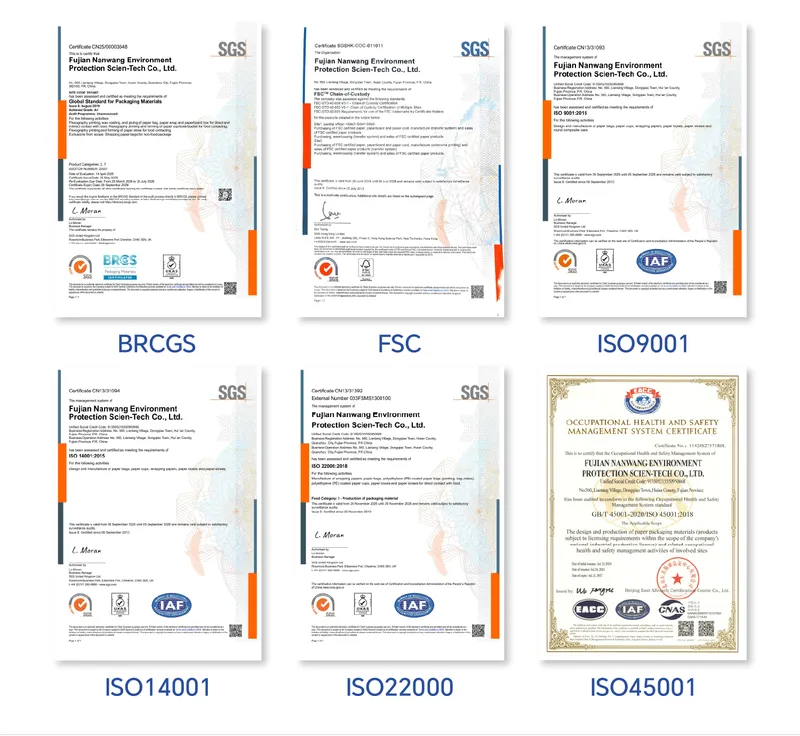
For paper bags, relevant testing may include:
- Paper properties: Grammage (GSM), thickness, moisture content, tensile strength, bursting strength, and stiffness.
- Printing performance: Color consistency, ink adhesion, dry and wet rub resistance, and ink migration where applicable.
- Structural performance: Handle pull strength, static load capacity, drop resistance, and bottom sealing strength.
- Food-contact safety: Relevant chemical and microbiological testing based on the intended packaging application.
You should also ask whether the manufacturer maintains long-term relationships with qualified paper mills and other raw material suppliers. Consistent paper specifications and controlled ink and adhesive quality are essential for maintaining product consistency across large orders.
If all testing is outsourced, ask how samples are selected, how long testing takes, and how production is controlled while results are pending.
A capable manufacturer should be able to explain its testing procedures, provide relevant reports, and show how inspection results are connected to production decisions.
At Nanwang, quality management covers raw material inspection, manufacturing control, and finished-product testing. Our paper packaging quality assurance system includes physical, chemical, and microbiological testing capabilities, together with product traceability procedures.
2. What Paper Weight and Coating Do You Recommend for My Application?
Be cautious if a sales representative provides a quotation before understanding what you intend to package.
A luxury retail shopping bag, a bakery bag, and a takeaway bag carrying hot, greasy food have very different material and performance requirements.
The correct paper specification depends on several factors:
| Specification | What You Should Evaluate |
|---|---|
| Paper weight (GSM) | Product weight, bag dimensions, carrying requirements, and expected handling conditions |
| Type de papier | Virgin kraft paper, recycled kraft paper, or other suitable paper grades |
| Revêtement | Water-based, bio-based, PE, or other application-specific barrier solutions |
| Bag structure | Bottom construction, side gussets, handles, and reinforcement |
| Impression | Color requirements, ink performance, and printing coverage |
| Surface performance | Resistance to moisture, grease, abrasion, and handling |
For example, a takeaway bag carrying fried food needs suitable grease resistance, while a retail shopping bag may prioritize appearance, handle strength, and carrying capacity.
The distinction between virgin pulp and recycled paper also matters. Both can serve different packaging applications, but their strength, appearance, fiber characteristics, and suitability for food contact should be evaluated according to the intended use.
Coating selection requires particular attention. Water-based and bio-based coatings may provide suitable barrier properties for certain applications, but their actual performance and end-of-life characteristics must be verified. Traditional plastic coatings may also affect recycling compatibility.
Ask your supplier to explain:
- Why a particular GSM is recommended.
- How the coating performs under actual moisture or grease exposure.
- Whether the material is suitable for direct food contact.
- How load-bearing performance is tested.
- Whether the proposed material meets your destination market’s requirements.
A professional manufacturer should recommend specifications based on the product’s weight, dimensions, moisture, oil content, and distribution conditions rather than simply offering the cheapest material.
Explore Nanwang’s sacs en papier de qualité alimentaire et sacs en papier pour la vente au détail to understand how different packaging structures serve different commercial applications.


3. What Happens If the Bulk Order Does Not Match the Approved Sample?
A production sample and a mass-production order are not the same thing.
A sample may be carefully adjusted and inspected before approval. However, when thousands of bags move through automated production lines, maintaining consistent dimensions, colors, printing quality, adhesive performance, and structural strength becomes much more challenging.
Before placing your order, ask the manufacturer to explain its quality control process.
In particular, find out whether it conducts:
- Incoming material inspections before production.
- First-article inspections after machine setup.
- In-process inspections during printing, cutting, folding, and bag making.
- Finished-product sampling before packaging and shipment.
- Final inspections against the approved sample and confirmed specifications.
You should also establish a written quality agreement before mass production begins.
This document should clearly define acceptable tolerances, material specifications, printing standards, sampling methods, defect classifications, and inspection procedures.
For example, if your approved sample uses a specific kraft paper grade and handle construction, the production batch should follow the same confirmed specifications unless a change has been formally approved.
Another important question concerns non-conforming products.
What happens if the delivered bags fail to meet the agreed requirements? Will the manufacturer investigate the root cause? Can it replace defective products, arrange rework, or provide another agreed remedy?
Do not rely on vague promises such as “We guarantee perfect quality.”
Ask for a documented quality assurance procedure and a clear process for handling customer complaints.
At Nanwang, paper bag manufacturing involves multiple inspection procedures, including handle pull testing, static load testing, drop testing, printing rub resistance testing, and dimensional inspection. These procedures help identify potential problems before products reach customers.

4. Can Your Production Capacity Handle Unexpected Disruptions?
Many suppliers advertise large production capacities. However, production capacity on paper does not necessarily translate into reliable delivery performance.
What happens if a key machine breaks down, raw material deliveries are delayed, or an unexpected increase in demand affects the production schedule?
These are the questions that distinguish a manufacturer with genuine operational resilience from one that simply promises high output.
Before choosing a supplier, investigate its manufacturing footprint and production management capabilities.
Consider asking:
- How many manufacturing facilities do you operate?
- Do you have multiple production lines for similar packaging products?
- Can production schedules be adjusted during peak seasons?
- How do you manage raw material inventory and supplier disruptions?
- Can you track production progress and identify the source of a quality issue?
Multiple manufacturing facilities can provide additional flexibility, but they do not automatically guarantee uninterrupted supply. You should confirm whether alternative facilities have compatible equipment, approved materials, available capacity, and the necessary quality controls.
Traceability is equally important.
A reliable manufacturer should be able to identify the raw material batches, production records, inspection results, and shipment information associated with a particular order.
This makes it easier to investigate defects, isolate affected batches, and prevent the same problem from recurring.
Nanwang has established manufacturing operations across multiple locations and operates more than 400 sets of advanced production equipment. Its company profile provides further information about its manufacturing network, equipment, and packaging capabilities.
For large-volume buyers, production resilience should be evaluated alongside price, product quality, and delivery lead time.
5. Can You Provide Verifiable Environmental and Regulatory Documentation?
Environmental claims are no longer just a marketing advantage. They increasingly affect whether packaging products can enter and remain in important international markets.
For companies exporting food-contact packaging to the European Union, the Packaging and Packaging Waste Regulation (PPWR) deserves particular attention.
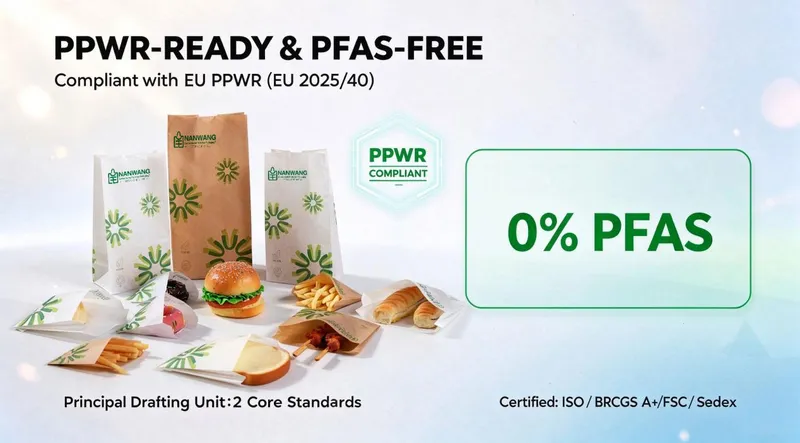
The PPWR began applying on August 12, 2026. Among its provisions, restrictions on PFAS in food-contact packaging also began applying on that date. Packaging exceeding the applicable PFAS concentration limits cannot be placed on the EU market.
This makes it important to verify material composition and obtain relevant supporting documentation before production and shipment.
Do not accept vague descriptions such as “100% eco-friendly,” “chemical-free,” or “fully sustainable” without supporting evidence.
Instead, ask your supplier for:
1. FSC Chain of Custody Documentation
If the packaging is marketed as FSC-certified, request the certificate number and verify that the certificate is valid and covers the relevant products and manufacturing activities. Also confirm that the product carries the appropriate FSC claim.
2. PFAS Testing Reports
For food-contact paper packaging, request relevant PFAS or fluorine testing reports. Confirm the testing scope, analytical methods, laboratory information, and whether the results address the applicable regulatory limits.
3. Coating and Material Information
Ask whether the coating contains conventional plastic, whether it is water-based or bio-based, and what evidence supports its claimed barrier and environmental performance.
4. Food-Contact Compliance Documents
Depending on the target market and application, request relevant food-contact declarations, migration test reports, and supporting material documentation.
5. Recyclability and End-of-Life Information
A paper-based structure does not automatically guarantee that a finished product is recyclable in every local collection and recycling system. Coatings, adhesives, inks, and composite structures should all be considered.
Nanwang has developed fluorine-free greaseproof paper bag solutions for food packaging applications. As a drafting unit for the T/CSTM 01169—2024 group standard, Evaluation of Fluorine-Free Grease-Resistant Plant Fiber-Based Materials for Food Contact, Nanwang has experience in developing materials designed for fluorine-free grease-resistant applications.
Notre fluorine-free greaseproof paper bags provide an option for businesses looking for alternatives to conventional grease-resistant packaging materials.
For buyers seeking responsibly sourced paper materials, Nanwang also maintains FSC-COC certification. Relevant certification and product documentation should be reviewed against the actual order and destination-market requirements.
6. How Quickly Can You Develop and Deliver a Prototype?
Sample development is more than a preliminary step in the purchasing process. It is also an indication of how effectively a supplier handles technical communication, design adjustments, and product development.
If a manufacturer takes an unusually long time to produce a basic prototype, it may struggle to respond quickly when your packaging design changes or peak-season requirements become urgent.
However, sample speed should never be evaluated in isolation.
A useful sample development process should include:
- Design review: Confirm bag dimensions, structure, artwork, paper specifications, and intended application.
- Material selection: Identify suitable paper grades, coatings, handles, adhesives, and printing materials.
- Prototype production: Produce a physical sample based on the confirmed specifications.
- Performance evaluation: Check dimensions, appearance, printing, structural strength, and application suitability.
- Sample approval: Confirm the final reference sample and technical requirements before mass production.
Before requesting a quotation, provide as much information as possible, including your bag dimensions, expected order quantity, artwork, paper requirements, handle style, and intended use.
This helps the manufacturer assess the project accurately and avoid unnecessary delays caused by repeated specification changes.
For customized paper packaging, ask the supplier to confirm sample charges, prototype lead time, revision arrangements, and the expected transition from sample approval to mass production.
A manufacturer with an organized development process can help you reduce uncertainty before committing to a large order.
Choose a Paper Packaging Manufacturer That Can Deliver Beyond the Sample
Selecting a bulk paper bag supplier is ultimately about reducing purchasing risks.
A competitive quotation may attract your attention, and an attractive sample may win your approval. But neither guarantees that the manufacturer can maintain quality, meet delivery schedules, and support your packaging requirements over the long term.
Before issuing a purchase order, evaluate the supplier’s laboratory capabilities, material recommendations, production quality controls, manufacturing resilience, environmental documentation, and sample development process.
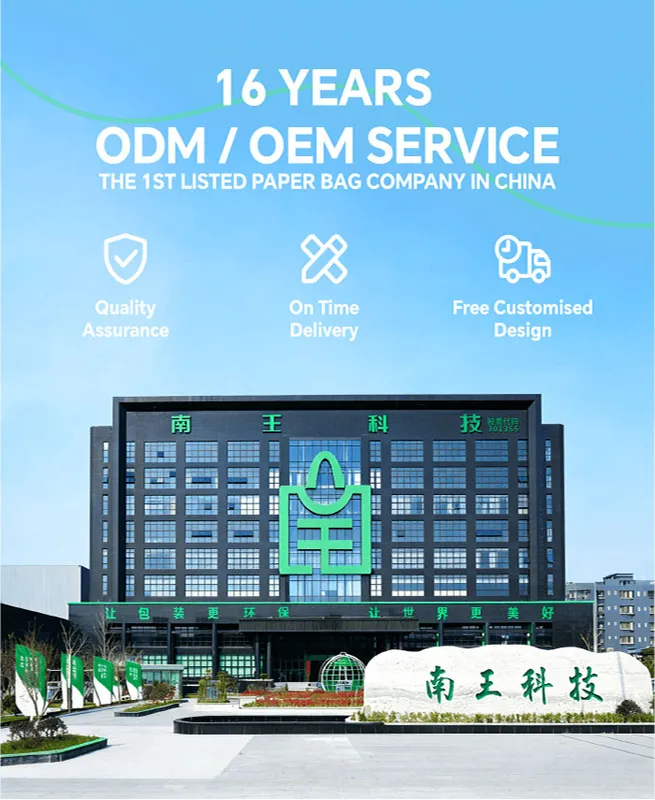
At Fujian Nanwang Environment Protection Scien-tech Co., Ltd. (Stock Code: 301355), we combine paper packaging manufacturing, in-house testing capabilities, material development, and quality management to support customers with diverse packaging requirements.
Established in 2010, Nanwang specializes in retail paper bags, food-grade paper bags, and food service packaging. With more than 400 sets of advanced production equipment, a comprehensive testing laboratory, FSC-COC certification, and experience in industry standard development, we work with customers to turn packaging requirements into practical production solutions.
Whether you are sourcing custom retail shopping bags, food delivery bags, greaseproof paper bags, or other paper packaging products, our team can help evaluate your specifications and discuss suitable manufacturing options.
Planning a bulk paper bag order?
Visit Nanwang Paper Packaging ou contact our team to discuss your product specifications, material requirements, and production plans.